Reviews
Publishers Weekly Pick of the Week!
8/24/2009
Coming to America
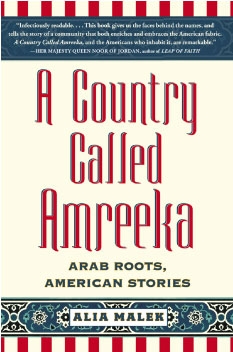
• The U.S. has long lauded itself as a nation of immigrants, but some communities have had considerable difficulty weaving themselves into the American tapestry, notably, Arab-Americans. In this superb snapshot of the Americans of Arab-speaking descent, individuals with roots in Jordan, Yemen, the Palestinian territories and Lebanon share their stories and demonstrate the extent to which, even as they play football, work assembly lines and hold public office, they remain shut out of the national narrative. With a remarkable ability to capture her subjects’ voices, Malek, a Syrian-American civil rights lawyer, sketches illuminating responses to her question: “What does American history look and feel like in the eyes and skin of Arab Americans?” There’s the Lebanese-American, too dark for 1960s Birmingham; the Palestinian-American surrounded by anti-Arab violence during the Iranian hostage crisis; the Yemeni-American deployed to Iraq with the Marine Corps. In her effort to demonstrate the impact of foreign affairs on American soil, Malek focuses too heavily on the Israeli-Palestinian conflict, giving short shrift to other important stories of upheaval, but this is an excellent book, one certain to put right some of the wrongs it catalogues. (Oct.)
R, KIRKUS, 8/1
A Syrian-American civil-rights lawyer and journalist examines the uneasy relationship that many Arab-Americans maintain with their adopted country.
There are about 3.5 million people of Arabic-speaking descent in America, writes Malek. However, “Arabs account for only about 25 percent of Muslims in America, and Arab-American Muslims still account for only about 24 percent of all Americans believed to be of Arab descent.” The author traces personal stories across generations of people who have arrived on American shores. Malek looks specifically at families who represent some fairly typical Arab-American stories, such as the Lebanese, Syrians and Palestinian Christians who made up the first Great Migration starting in 1880. In Birmingham, Ala., these were largely unskilled laborers, like Ed Salem and his family, who found work in the mines, opened grocery stores and shops and were lumped in with other “darkies” (dagos) and similarly discriminated against. When President Johnson signed the Immigration and Naturalization Act of 1965, a new openness allowed entrance to many refugees from the political upheaval in the Middle East, such as Jordanians, Egyptians, Iraqis and Yemenis. Many settled near Detroit, where they anglicized their names and got jobs at the Ford Motor Company. In the late ’60s and ’70s, they also began to grow politicized, as the country reacted to the energy crisis, PLO terrorism and the Iranian revolution. Arab-Americans, regardless of ethnicity, were stereotyped as primitive and evil, and targeted for violence, such as the bombing death of Alex Odeh in Santa Ana, Calif., in 1985. Malek provocatively explores how the Gulf wars negatively affected Arab-Americans and how 9/11 singled out their communities in both a hostile and more inclusive fashion.
A significant, timely contribution to the understanding of the Arab-American story.
September 1, 2009
What is it like to be Arab American? What does American history look like for those stereotyped as oil-rich sheiks or terrorists? Syrian American civil rights lawyer Malek tells us in a direct, open style through diverse individual stories, not to separate Arab Americans but to “fold their experiences into the mosaic of American history and deepen our understanding of who we Americans are.” It works beautifully, because each chapter is based on her personal interview with one Arab American in a particular place, from an auto worker in Dearborn to a bellhop in Chicago, and with a focus on one political event. Starting with the Lebanese community in Birmingham after the 1963 church bombing, she discusses the landmark 1965 Immigration Law, the Gulf War, 9/11, and up to the present, where technology has shrunk the break with
the old country. In an entertaining final section, two dynamic women talk about working the 2000 election, one for Gore, one for Bush.
An essential addition to the Booklist Core Collection: “The New Immigration
Story”.
— Hazel Rochman